Barbara
An online renewable energy degree is a university-level programme, usually a bachelor’s or master’s, that you complete mostly or entirely through distance learning, covering solar, wind, bioenergy, storage, grids and energy policy. Done well, it gives you the same academic footing as an on-campus course, with the flexibility to study around a job. Done poorly, it’s a stack of video lectures with a certificate at the end. The difference comes down to accreditation, practical content and how the programme fits your career goals.
In Europe, that quality question has useful reference points. Under the Bologna Process, programmes carry ECTS credits and map to levels of the European Qualifications Framework (EQF), so you can compare a degree across borders and check whether employers and universities will recognise it. A bachelor’s typically sits at EQF level 6, a master’s at level 7.
The demand side is just as clear. The EU’s energy transition needs people who can design PV systems, integrate storage, assess wind sites and read regulatory frameworks, not only people who understand the theory. That’s why practical application matters so much in an online format: simulations, design projects and real-world datasets have to replace the lab bench.
This article walks you through what a degree involves, how to verify its credibility, how it compares with shorter training, and what careers it can lead to.
What an Online Renewable Energy Degree Actually Is
Degree Levels and Formats: Bachelor’s, Master’s and Beyond
Online renewable energy study usually comes at three levels. A Bachelor’s degree (typically 180 to 240 ECTS credits) builds broad foundations in energy systems, electrical basics and sustainability. A Master’s degree (usually 60 to 120 ECTS credits) goes deeper into a specialism such as photovoltaics, wind, storage or energy management, and often suits people who already hold a technical or science qualification. Beyond that, doctoral research and postgraduate certificates or diplomas offer paths for those wanting advanced expertise or a focused, shorter credential.
ECTS stands for the European Credit Transfer and Accumulation System. One credit represents roughly 25 to 30 hours of student work, which makes it easy to judge the real workload of a programme. The European Qualifications Framework (EQF) sorts qualifications into eight levels, with Bachelor’s degrees generally at level 6 and Master’s degrees at level 7. Together, these tools help you compare qualifications across countries and understand how a programme from one university stacks up against another.
Formats differ too. Fully online programmes deliver everything remotely, using live or recorded lectures, virtual labs and online exams. Blended models keep most teaching online but add short on-site phases, such as a lab week, a field visit or a group project, where you work with real equipment. Neither is automatically better. Fully online suits those who need maximum flexibility, while blended formats appeal to learners who want guided hands-on experience alongside remote study.
How Distance Learning Works in a Technical Field
Most online renewable energy programmes combine several formats rather than relying on one. Recorded lectures let you work through demanding material, such as power electronics or energy economics, at your own pace, pausing and rewatching a derivation until it clicks. Live sessions then add structure, giving you a chance to ask questions, discuss case studies and hear how lecturers approach real engineering problems.
The hands-on side is handled through virtual labs and simulation software. Instead of wiring a physical panel array, you might model a photovoltaic (PV) system in design software, adjust tilt and shading, and see how output changes across a year. Wind resource assessments, battery sizing and grid load studies work in much the same way. Tutors and teaching assistants review your results, correct misunderstandings and push you toward better design choices, usually through forums, scheduled office hours or one-to-one video calls.
Collaboration is built in too. Group projects, often run in international teams, mirror how project developers and system integrators actually work, coordinating across locations and time zones. Assessment typically mixes coursework, project reports and exams, which are either taken online under supervision or at a partner test centre.
So do technical subjects translate well to remote study? For most of the theory and analysis, yes. Calculations, modelling and design are naturally digital, and these are the tools professionals use daily. The honest limitation is physical contact with equipment, which is why many European programmes add short on-site phases or encourage you to apply what you learn in your own workplace.
What You Will Study: Core Topics and Specialisations
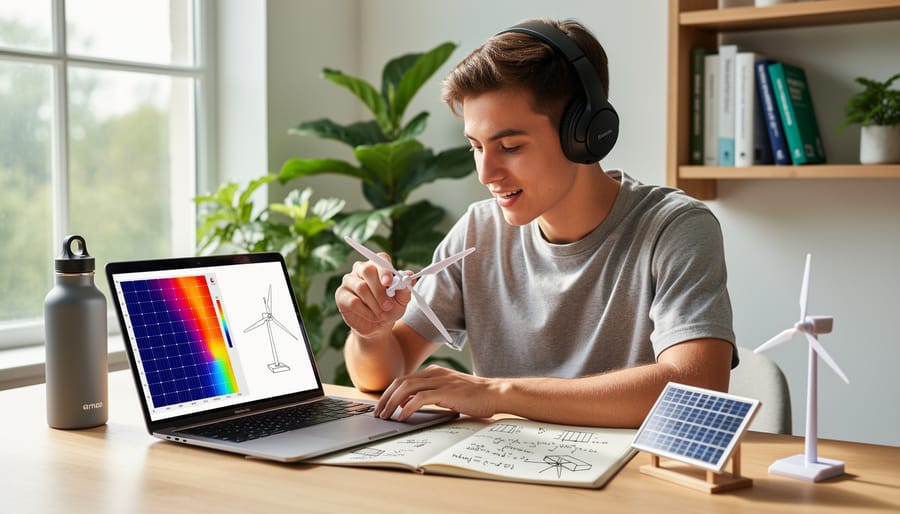
Foundation Subjects Across All Technologies
Every online renewable energy degree rests on a shared foundation, whichever technology you later specialise in. It starts with energy system fundamentals: how energy is generated, converted, transported and used, and why the balance between supply and demand matters. If you are new to the field, brushing up on renewable resource basics makes these early modules much easier.
Thermodynamics and electrical basics come next. You learn why no conversion process is perfectly efficient, how heat flows, and how voltage, current and power behave in AC and DC circuits. These principles explain everything from why a solar panel loses output as it heats up to how a wind turbine feeds a grid.
Energy economics turns technical ideas into investment decisions. Expect to work with concepts such as levelised cost of energy (LCOE), which compares the lifetime cost of different generation options, alongside payback periods and financing models.
The policy and market side gets a distinctly European lens. Courses typically cover EU climate targets, the Renewable Energy Directive and the way electricity markets are designed to integrate variable generation. Sustainability principles tie it together, teaching you to weigh environmental, social and economic impacts across a project’s whole life cycle.
Technology Specialisations: Solar, Wind, Storage and More
Most programmes let you choose a specialisation once the shared foundations are covered. The exact names vary between universities, but the tracks below appear most often, and each builds a different set of practical skills.
Photovoltaic (PV) tracks focus on solar cell physics, module selection and system design. You learn to size an array, estimate annual yield and check inverter compatibility, often using industry design software. Solar thermal tracks cover collectors, heat transfer and storage tanks, with skills in sizing systems for hot water or district heating.
Wind specialisations start with wind resource assessment and turbine aerodynamics. If you want a refresher before choosing this route, our guide to wind energy basics explains why the resource is so dependable. Beyond that, expect work on site analysis, energy yield modelling and the engineering of foundations and blades.
Storage tracks explore batteries, thermal storage and pumped hydro. They build skills in sizing storage for a given load, understanding degradation and evaluating how storage supports grid stability. Hydrogen tracks look at electrolysis, fuel cells and the safety and cost questions around producing, transporting and using hydrogen.
Bioenergy specialisations cover biomass supply chains, biogas and sustainability criteria, which matters for European compliance. Energy efficiency in buildings, the most accessible track for many professionals, teaches energy audits, heat pumps, insulation strategies and the performance standards used across the EU.
Choose the track that matches the work you want to do, since each leads to a different daily practice.
Learning by Doing: Practical Skills in an Online Setting
Simulation, Design Software and Virtual Labs
Most of the hands-on work in an online programme happens inside software. Students use simulation and design tools to run the same calculations a project team would run before a single panel is ordered, which is why this part of the course is so valuable.
Take a PV system. Learners enter a site location, roof or ground layout, shading conditions and load profile, then size the array and inverter and check the predicted annual yield. Many students find that this is where the theory finally clicks, and if you want to master solar properly, repeated practice with design tools is hard to beat.
Wind works in a similar way. Students import wind speed data for a candidate site, apply terrain and turbine characteristics, and estimate energy production and capacity factor. Changing the hub height or turbine model and watching the numbers shift teaches the trade-offs far faster than a textbook table.
Storage adds another layer. Learners test battery sizes and dispatch strategies against real consumption and generation curves, then compare cost, self-consumption and grid impact. Some programmes also include virtual labs where you can run electrical measurements or fault scenarios safely.
The tools are often professional-grade or close relatives of them, so the skills carry straight into project development and system integration work. When you compare programmes, ask which software is used and whether you get hands-on assignments with it, not just demonstrations.
Combining Online Study With Real Projects
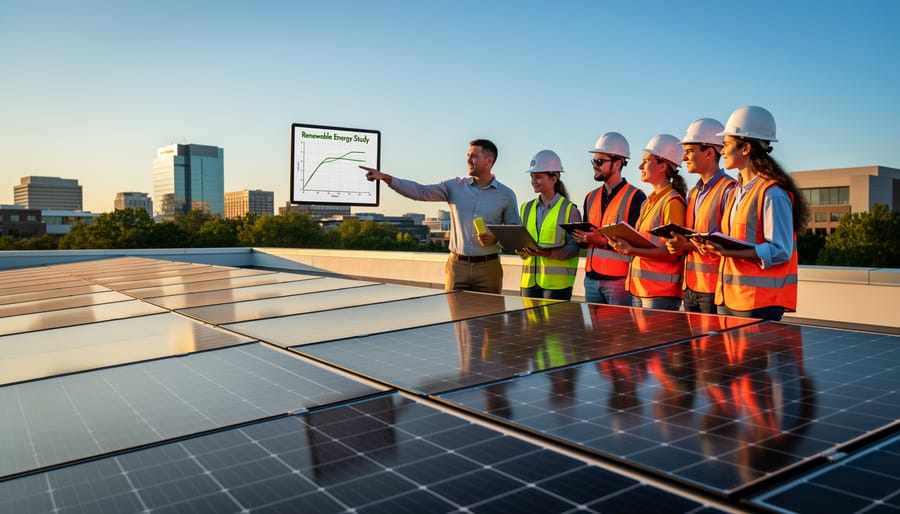
One of the biggest advantages of studying online is that your working life doesn’t have to pause while you learn. Many students keep their jobs and treat their workplace as a living case study. If you work for an installer, a utility or a municipal energy office, you can often shape assignments around real questions you already face, such as assessing a rooftop for solar, reviewing a building’s energy use or comparing financing options for a small wind installation.
Local projects offer another route. Community energy cooperatives, school retrofits, farm-based biogas plants and regional heat network initiatives all welcome motivated volunteers or student contributors. Taking part gives you a chance to test classroom methods against messy, real-world constraints like shading, grid connection limits or planning permissions. It also gives you concrete experience to point to in a portfolio or interview.
Some programmes build this in formally. Placements, work-based projects or a thesis carried out with a partner company let you earn credit for applied work. Blended models go a step further by adding short on-site phases, typically a few days or a week, in which you handle equipment, take field measurements and work alongside instructors and peers in a physical lab or at a test site.
If you’re weighing programmes, ask how they support applied work and whether on-site phases are compulsory or optional. The best fit is one that lets you practise what you study while you’re still studying it.
Checking Quality: Accreditation and Recognition in Europe
Not every online programme carries the same weight, so it pays to check a few things before you enrol. A simple framework helps you separate credible degrees from weak ones.
Start with the institution itself. A legitimate programme is awarded by a university or higher education institution that is officially recognised in its home country. Most European countries have a national quality assurance agency or a ministry-level register where you can confirm this. If you cannot find the institution listed, treat that as a warning sign.
Next, look at accreditation. In Europe, quality assurance follows shared standards, usually called the European Standards and Guidelines for Quality Assurance. National agencies review programmes against them, and many of those agencies are listed in the European Quality Assurance Register for Higher Education. Check whether the degree itself, not just the institution, has been accredited or evaluated. Some programmes also hold subject-specific or professional accreditation, which can matter if you plan to work in regulated engineering roles.
The Bologna Process is your friend here. It aligns degree structures across more than 40 countries in the European Higher Education Area, using a common cycle system (Bachelor’s, Master’s, doctorate) and ECTS credits. A programme that clearly states its cycle, ECTS workload and learning outcomes is easier to compare and more likely to be recognised elsewhere. Ask where the qualification sits on the European Qualifications Framework or the national equivalent.
Recognition across borders is not automatic, though. If you plan to work or study in another country, check how that country’s recognition body treats foreign degrees. The ENIC-NARIC networks exist to help with exactly this.
Finally, consider how employers see online study. In practice, many European employers focus on the awarding institution, the content and what you can demonstrate, rather than the delivery format. A degree from a recognised university that happens to be taught online is generally judged on the same terms as a campus one. What tends to matter more is evidence of applied skills, such as design projects and software proficiency.
A quick checklist helps:
– Is the awarding institution officially recognised?
– Is the programme accredited or quality-assured by a credible agency?
– Does it state ECTS credits and its level in the qualifications framework?
– Is the curriculum transparent, with clear practical components?
– Can you speak to graduates or see how they use the qualification?
Spending an hour on these questions can save you a costly mistake.
Degree, Certificate or Short Course: Choosing the Right Route
The right choice depends on where you are in your career and what you need to do next. A full degree builds broad, recognised foundations. Focused training builds specific skills fast. Neither is better in every case.
If you are starting out, changing careers, or aiming for roles that expect a formal qualification, a degree usually makes sense. If you already work in the sector and need to close a particular gap, such as sizing PV systems or understanding wind site assessment, a shorter route can deliver results in weeks rather than years.
Pros
- A degree gives deep, structured coverage of energy systems, economics and policy that short courses rarely match.
- A formally recognised qualification, often with ECTS credits, is easier to compare across European countries and employers.
- Short courses and seminars are quick to complete and can be applied at work almost immediately.
- Modular training lets you learn one technology at a time and pay as you go.
Cons
- A full degree demands a significant investment of time and money, usually over several years.
- Degree content can be broader than the narrow skill a specific project requires.
- Short courses typically do not carry the same formal academic recognition.
- Stacking many separate short courses can leave gaps in underlying theory if you do not plan the sequence.
The two routes also combine well. Many professionals start with targeted learning to prove a skill set, then move into a degree later, or take seminars and summits alongside their studies to stay current and meet peers. That mix keeps theory and practice connected.
For applied, fast upskilling, platforms like Adapted Learning with Renewables offer focused training in PV, wind and solar thermal, built around what project developers and system integrators actually do on the job. If solar is your priority, this guide on how to choose solar training explains what to look for before you commit.
A useful test is to ask what decision you are trying to unlock. If it is a promotion, a new role, or a credential employers explicitly require, lean toward a degree. If it is a skill you need on your next project, lean toward short-form training.
Career Paths and Who Benefits Most
An online renewable energy degree opens several doors, and most of them sit at the point where technical knowledge meets planning, finance or policy. Project developers use it to assess site potential, permitting steps and project economics. System integrators apply it to combine PV, storage and grid connections into working installations. Energy consultants and energy efficiency specialists translate technical options into practical advice for homes, businesses and public buildings. Policy analysts draw on the regulatory and market-design content to interpret EU climate targets and the Renewable Energy Directive, while sustainability managers use the same foundations to guide organisations through decarbonisation plans.
If your goal is hands-on field work, a degree isn’t the only route. The wind technician pathway shows how vocational training can lead directly to technical roles, and some graduates combine both routes over time.
Who benefits most? Career changers gain a structured, recognised route into a new sector without leaving their current job. Working professionals can add energy expertise to an existing background in engineering, finance, construction or law, often applying coursework directly to live projects. International learners get access to European programmes and the European perspective on energy systems without relocating. Organisations can also upskill whole teams, building shared language and skills across departments.
The broader context helps. Europe’s energy transition is moving renewables, storage, electrification and efficiency measures steadily into the mainstream, and that shift calls for people who understand both the technology and the market and policy framework around it. Employers in this space tend to value applied competence, so graduates who can show real projects, simulations or design work alongside their qualification stand out. Think of the degree as the foundation, and your practical portfolio as the proof that you can use it.
Making Online Study Work: Practical Tips for Success
Studying online gives you freedom, but that freedom only pays off with a bit of structure. The approach below works for most learners, whether you’re a working professional or a career changer.
- Define your goal first. Decide whether you want to move into project development, system integration, consulting or policy, then pick a specialisation that matches.
- Check accreditation and ECTS credits. Confirm the programme is recognised in your country so the qualification travels with you across Europe.
- Review the curriculum in detail. Look for modules in PV, wind, storage or energy efficiency that match your target role, plus design software and projects.
- Test the platform before committing. Ask for a demo lecture or trial access to see how live sessions, tutor support and virtual labs actually feel.
- Plan your study time realistically. Block fixed weekly slots, even if that’s only six or eight hours, and protect them like client meetings.
- Apply your learning to real projects. Size a rooftop PV system for a local building or analyse your own workplace’s energy use as coursework.
Once you’ve started, consistency matters more than intensity. Short, regular sessions beat weekend marathons, and a dedicated study space helps your brain switch modes.
Distance learning can feel isolating, so build your network on purpose. Join course forums, form small study groups and connect with classmates and tutors on professional platforms. Industry webinars, seminars and summits are also worth attending, since they show how the European energy transition looks in practice and often lead to useful contacts.
Finally, review your plan every few months. If your schedule or goals change, a modular route or targeted short course can fill gaps without derailing your degree.
Common Questions About Online Renewable Energy Degrees
Are online renewable energy degrees taken seriously by employers?
Yes, when the programme is properly accredited and the graduate can show applied skills. European employers tend to care less about the delivery format and more about recognised credentials, demonstrable project experience and fluency with industry tools such as PV design and simulation software.
Can I really learn technical subjects without a physical lab?
Largely, yes. Virtual labs and simulation software cover a great deal, from sizing a PV system to modelling a wind site. Some programmes add short on-site phases for hands-on work, so check whether that matches your learning style.
How long does it take to finish?
It depends on the level and your pace. Full-time study usually follows the standard length of a Bachelor’s or Master’s, while part-time routes stretch over more years to fit around work. Compare programmes by their ECTS credits (the European credit system), which show the total workload involved.
Do I need an engineering background?
Not always. Many Master’s programmes welcome career changers with related degrees or relevant experience, and some offer bridging modules in maths, physics or electrical basics. Entry requirements vary, so read them carefully before applying.
Will my degree be recognised in other European countries?
Programmes that sit within the Bologna Process and map to the European Qualifications Framework are designed to be comparable across countries. Still, recognition for regulated professions can differ by country, so confirm with the relevant national authority if you plan to work abroad.
Is a degree better than a short course?
Neither is better in every case. A degree builds broad foundations and suits long-term career moves, while focused courses suit professionals who need specific skills quickly. Plenty of learners combine the two over time.
Do I need to be a strong self-starter?
It certainly helps. Online study rewards a steady routine, clear weekly goals and regular contact with tutors and fellow students, which keep you motivated and on track.
An online renewable energy degree can be a credible, flexible way into the sector, provided you choose it with care. Check that the programme is properly accredited, look at how it builds practical skills through simulation software, design tools and real projects, and make sure its specialisations match the career you want. A degree is not the only route, either. If you need applied knowledge fast, focused courses and seminars can fill specific gaps, and many learners combine both over time.
What makes this moment encouraging is access. Distance and online renewable energy learning lets people across Europe study solar, wind, storage and energy efficiency without relocating or leaving their jobs, and the energy transition needs exactly that breadth of skilled people.
Your next step is a simple one. Compare a few programmes, decide how much time you can commit, and explore the courses and training options that fit your goals. A laptop and a clear plan are a solid place to start.