Barbara
Costco’s solar firefly lights currently retail for $13.99 to $14.99 in the United States, making them one of the most competitively priced decorative solar lighting options available through warehouse retail channels in 2026. These ambient LED string lights, which simulate the flickering glow of fireflies through their solar-powered illumination, represent an accessible entry point into consumer solar technology for both North American and European households evaluating renewable energy applications at the residential scale.
The pricing structure reflects the economics of mass-market solar products: lower-capacity photovoltaic cells paired with nickel-metal hydride or lithium-ion battery storage, designed for decorative rather than functional lighting. Costco’s wholesale purchasing model enables this competitive positioning, though availability varies significantly by warehouse location and season, with peak inventory typically appearing during spring and summer months.
Three primary factors drive cost variation within this product category. Panel efficiency determines the charge rate and operational duration after sunset, with higher-efficiency monocrystalline cells commanding premium pricing over polycrystalline alternatives. LED count and spacing affect both material costs and light distribution, while housing materials (ranging from basic plastics to weather-resistant composites) influence durability and long-term value. For European readers familiar with solar photovoltaic principles from utility-scale installations, these consumer products offer a practical demonstration of how the same energy conversion technology scales down to micro-applications, though efficiency metrics remain notably lower than rooftop or ground-mounted systems.
Understanding these cost drivers helps consumers evaluate whether DIY installation of individual solar string lights delivers better value than integrated outdoor lighting systems.
Current Costco Solar Firefly Light Pricing
The Fresh Source Solar Firefly Landscape Lights retail at Costco for a verified price range of $13.99 to $14.99 per four-pack. This pricing applies to the product identified by Costco product number 4000414729, which has been spotted at 516 Costco warehouse locations across the United States. All pricing information reflects US dollars only, as Costco’s European operations carry different product lines with separate pricing structures that we cannot verify for this specific model.
Each four-pack contains four individual stake units, and each stake features eight separate LED lights arranged to create the distinctive firefly effect. This configuration delivers 32 total LED lights per package, translating to approximately $0.44 to $0.47 per individual light at the current price point. The modest price difference between locations typically reflects regional variations in Costco’s pricing strategy rather than product differences, as the item specification remains consistent across warehouses.
The sub-$15 price point positions these solar landscape lights as an accessible entry into renewable energy technology for residential applications. Unlike premium solar lighting systems that can exceed $50 per fixture, the Fresh Source model prioritizes affordability while maintaining the core functional benefits of solar power: no electrical wiring requirements, automated dusk-to-dawn operation, and zero ongoing electricity costs. This pricing structure makes solar decorative lighting practical for larger landscape areas where traditional wired fixtures would require professional installation and significantly higher upfront investment.
Cost by Pack Size and Configuration
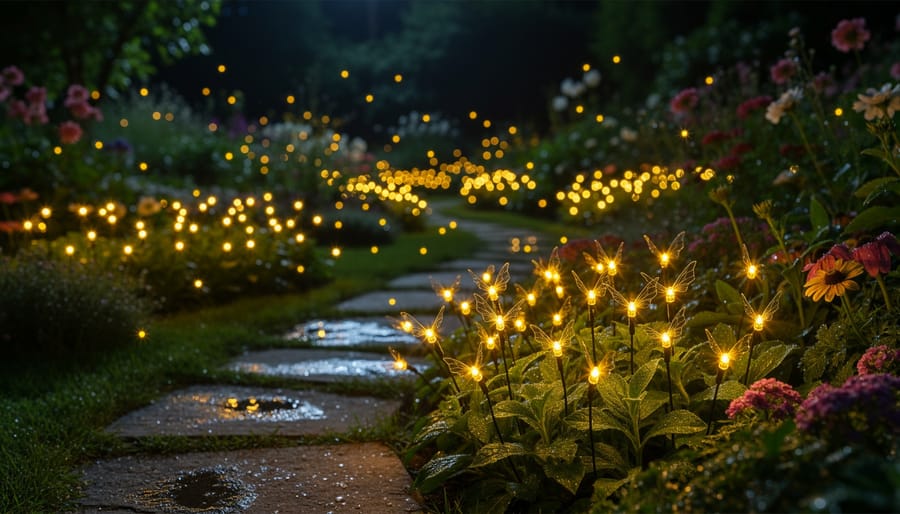
The Fresh Source Solar Firefly Lights sold at Costco follow a 4-pack configuration that delivers surprising value when you break down the numbers. Each pack contains four individual stakes, and each stake holds eight miniature LED lights. This gives you 32 individual lights total for the $13.99 to $14.99 price point. When you calculate the cost per individual LED, you’re looking at roughly 44 to 47 cents per light, a remarkably low entry price for solar-powered outdoor illumination.
| Pack Size | Total Lights | Price Range (USD) | Cost Per Light |
|---|---|---|---|
| 4-pack | 32 lights (8 per stake) | $13.99, $14.99 | $0.44, $0.47 |
This configuration differs from many solar landscape lighting products that sell individual units or pairs. The 4-pack structure addresses typical residential landscaping needs, enough coverage for a garden bed, pathway section, or decorative border without requiring multiple purchases. Having eight lights per stake creates the “firefly” visual effect rather than a single bright point, which means you get more distributed illumination from each unit you place in the ground.
The per-light cost becomes particularly relevant when comparing to traditional solar pathway lights or garden spotlights, which often sell individually for several dollars each. Even basic solar stake lights typically range from three to ten dollars per unit depending on brightness and build quality. The Fresh Source configuration essentially bundles multiple small LEDs into each stake, reducing the per-light cost while maintaining the visual effect that gives these lights their firefly name.
From a practical standpoint, this pack size lets you test solar decorative lighting in your outdoor space without significant financial commitment. Four stakes with their 32 combined lights provide enough coverage to evaluate performance, solar charging efficiency in your specific location, and durability through seasonal weather changes. You’re not locked into a large upfront investment before understanding how the technology performs in your garden conditions or whether the aesthetic matches your landscape design preferences.
What Influences Solar Firefly Light Pricing
Understanding what drives the cost of solar decorative lights helps you assess value beyond the price tag. While the Fresh Source Solar Firefly Lights at Costco retail for $13.99-$14.99, their construction reflects broader cost principles that apply across solar lighting products. These factors explain why some solar lights command higher prices than others, and why certain features matter for long-term performance.
Solar panel efficiency sits at the heart of pricing differences. Higher-efficiency photovoltaic cells convert more sunlight into electricity per square centimetre, which means smaller panels can generate adequate power for evening operation. Cheaper lights often use larger, less efficient panels to compensate for lower conversion rates. The panel’s durability matters too: UV-resistant coatings and weather-sealed connections prevent degradation over seasons, extending the product’s useful life but adding to manufacturing costs.
LED quality and quantity directly affect both brightness and longevity. Premium solar lights use LEDs rated for 50,000 hours or more, with consistent colour temperature and minimal lumen degradation over time. The number of LEDs per fixture also influences price. The Fresh Source model includes eight lights per stake, offering more coverage than single-bulb designs. Lower-cost alternatives may use fewer, dimmer LEDs that fail sooner or produce uneven light output.
Battery capacity determines how long your lights shine after sunset. Several factors influence solar light pricing:
- Solar panel efficiency and conversion rate
- LED chip quality and lifespan ratings
- Battery chemistry (NiMH vs. lithium) and capacity
- Weather-resistant housing materials (ABS, polycarbonate, stainless steel)
- Sensor technology for automatic dusk-to-dawn operation
Most solar garden lights use nickel-metal hydride (NiMH) batteries, which offer decent performance at moderate cost. Lithium-ion batteries charge faster and handle temperature extremes better, but they increase the retail price. Battery capacity, measured in milliampere-hours (mAh), dictates runtime. A 600mAh battery might provide six hours of light, whilst a 1200mAh cell could last twice as long on a full charge.
Weather-resistant materials protect the internal components from rain, snow, and temperature swings. Polycarbonate lenses resist UV yellowing better than cheap acrylic, whilst stainless steel stakes outlast painted metals that rust. The sealing quality around solar panels and battery compartments prevents moisture intrusion that would kill electronics. These engineering choices add to production costs but prevent premature failure.
Automatic dusk-to-dawn sensors eliminate manual switching, using a light-sensitive photoelectric cell to detect ambient conditions. This convenience feature appears even in budget models like the Fresh Source lights, but sensor quality varies. Better sensors respond reliably in low-light conditions and avoid false triggering from shadows or nearby artificial light. The difference between a reliable sensor and an erratic one often separates functional solar lights from frustrating ones.
Fresh Source Solar Firefly Features and Specifications
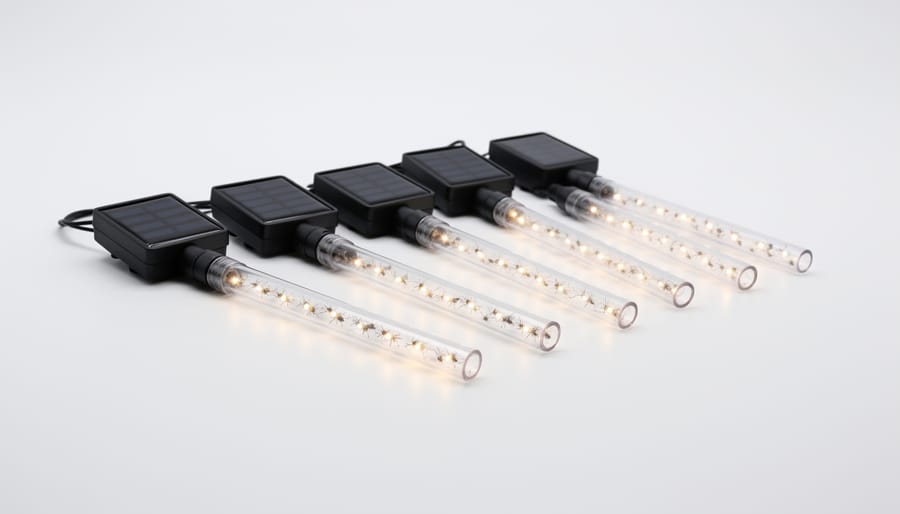
The Fresh Source Solar Firefly Landscape Lights sold at Costco deliver specific technical features that make them practical for residential outdoor use. Each 4-pack contains four individual stakes, and each stake holds 8 individual LED lights arranged along its length, providing 32 total light points per package. This multi-light configuration creates the distinctive “firefly” visual effect, with numerous small lights rather than a single bright bulb.
The lights operate on a fully autonomous solar system. Each stake includes a small photovoltaic panel that charges an integrated battery during daylight hours. The system employs an automatic dusk-to-dawn sensor that activates the LEDs when ambient light drops below a threshold and deactivates them at sunrise, requiring no manual switching or timer programming. This automation demonstrates a practical application of light-sensitive control circuits common in residential solar installations.
From a renewable energy perspective, these landscape lights illustrate several core solar technology principles. The photovoltaic cells convert sunlight into electrical energy through the photovoltaic effect, storing it in rechargeable batteries for later use. The system operates entirely off-grid, eliminating wiring requirements and demonstrating energy independence at a small scale. The LED technology maximizes runtime from limited battery capacity, as LEDs draw significantly less current than incandescent alternatives whilst providing comparable illumination.
The stake-mounted design suits landscape applications such as garden borders, pathways, flower beds, and decorative outdoor spaces. Weather-resistant construction allows year-round outdoor placement, though solar charging efficiency varies with seasonal sunlight availability. Each unit functions independently, allowing flexible placement without electrical infrastructure constraints. This accessibility makes them a tangible entry point for understanding how solar technology translates from large-scale renewable installations to consumer products.
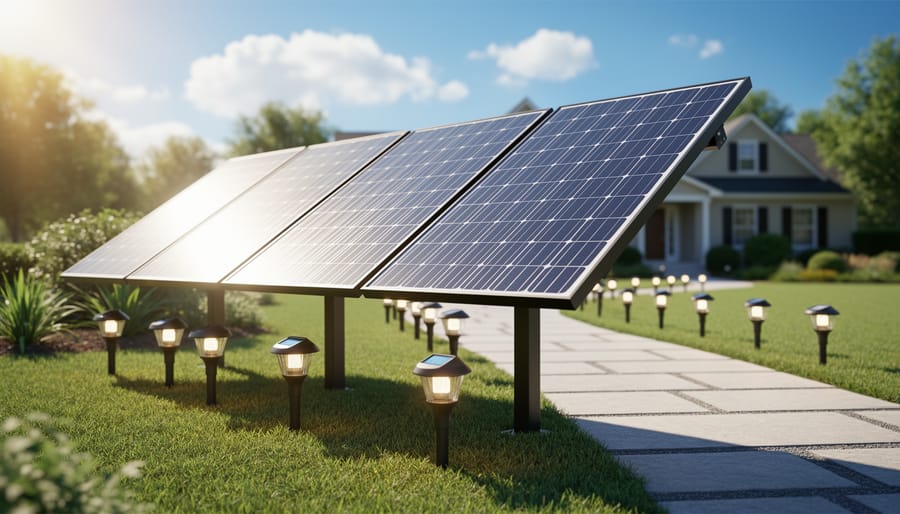
Installation: DIY vs. Professional Setup
Solar firefly lights represent one of the most accessible entry points to renewable energy technology precisely because they eliminate traditional installation barriers. The Fresh Source Solar Firefly Landscape Lights sold at Costco require no electrical wiring, no circuit integration, and no professional expertise to deploy effectively.
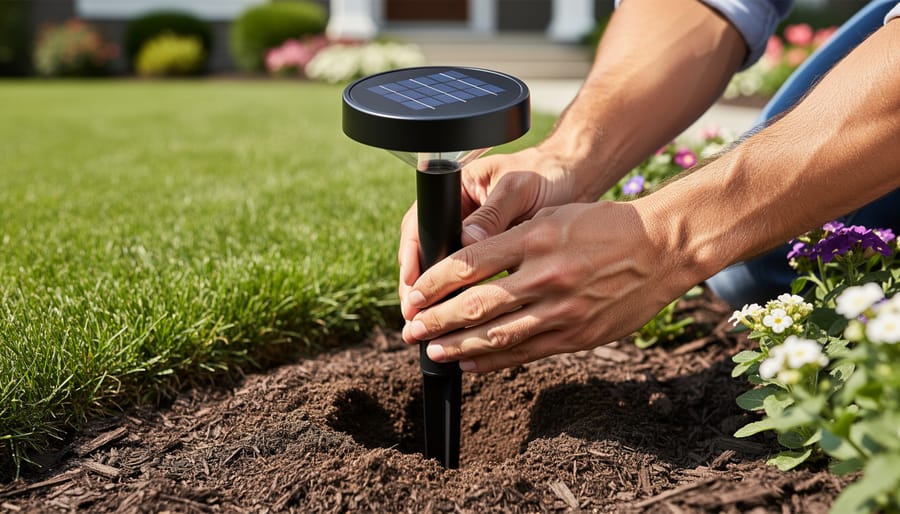
Installation is genuinely straightforward. These lights use a stake design that pushes directly into soil, lawn, or garden beds. The solar panel integrated into each stake handles all power generation autonomously, and the automatic dusk-to-dawn sensor manages operation without any programming. You’re essentially placing self-contained lighting systems where you want illumination.
- Choose locations with direct sunlight exposure for at least six hours daily. Avoid shaded areas under eaves, dense foliage, or north-facing positions that receive limited sun in European climates.
- Space the stakes according to your desired lighting effect, closer placement creates concentrated glow zones, while wider spacing (1-2 metres apart) produces ambient pathway lighting.
- Check the ground conditions. If soil is compacted or contains heavy clay, pre-water the area or create pilot holes with a screwdriver to prevent stake damage during insertion.
- Push each stake firmly into the ground until the base sits stable, ensuring the solar panel faces upward without obstruction from nearby plants or structures.
The initial charge typically requires 6-8 hours of direct sunlight before first use, after which the cycle becomes self-sustaining.
Contrast this with professionally installed landscape lighting. Traditional low-voltage systems require buried cable runs, transformer installation connected to mains power, and junction box configurations, work that necessitates licensed electricians in most jurisdictions. Professional installation costs typically range from €200-€500 for comparable coverage, not including ongoing electricity consumption.
Solar eliminates these complexities entirely. There’s no electrical load added to your home’s circuit, no trenching required for cable burial, and no building permit considerations. This accessibility demonstrates a core renewable energy principle: distributed generation at the point of use removes infrastructure dependence. The technology handles energy capture, storage, and deployment autonomously within each unit, making sustainable lighting genuinely achievable for anyone capable of pushing a stake into soil.
Educational Value: Small-Scale Solar Technology
These unassuming garden lights demonstrate core renewable energy principles that form the foundation of larger solar installations. Each stick contains a miniature photovoltaic system operating on the same fundamental technology that powers residential arrays and utility-scale solar farms across Europe.
The photovoltaic cells in these lights convert sunlight directly into electrical energy through the semiconductor effect. While small in scale, they illustrate the same energy conversion process used in commercial solar panels. During daylight hours, the cells generate current that charges an integrated battery, storing energy for nighttime use. This energy storage cycle mirrors the challenge faced by grid-scale renewable systems, where generation and demand rarely align perfectly.
The automatic dusk-to-dawn sensor adds another educational layer. This simple light-sensing circuit demonstrates automated energy management, switching loads based on available resources. At a fundamental level, this represents the same challenge addressed by sophisticated battery management systems and grid integration technologies in larger renewable installations.
For educational programmes focused on renewable energy principles, consumer products like these offer tangible examples students can examine directly. The components are visible, the energy flows are observable, and the technology operates at a scale that makes concepts concrete rather than abstract. A student can trace the complete energy pathway from photon absorption to LED illumination, understanding efficiency losses and storage limitations in a physical system they can hold.
The affordability of these lights removes financial barriers to hands-on learning. At roughly £11-12 for a 4-pack, they cost less than most textbooks yet provide direct experience with photovoltaic conversion, battery storage, and automated sensing. This practical demonstration reinforces theoretical concepts covered in renewable energy curricula, making solar technology accessible for classroom experimentation and home observation alike.
Frequently Asked Questions
Are Costco Solar Firefly Lights currently available?
The Fresh Source Solar Firefly Landscape Lights are available at approximately 516 Costco warehouse locations across the United States, with pricing ranging from $13.99 to $14.99 for a 4-pack. Availability varies by location, so checking your local warehouse or Costco’s website for stock status is recommended before making a trip.
How do the solar panels charge these lights?
These decorative lights use solar photovoltaic cells to convert sunlight into electrical energy during daylight hours. The integrated panels charge internal batteries throughout the day, storing sufficient power to illuminate the 8 LED lights per stick from dusk until dawn. Unlike wind energy basicshydro power or solar distilling these small-scale photovoltaic applications require only direct or indirect sun exposure for several hours daily to function effectively.
How long do solar firefly lights typically last?
Consumer-grade solar landscape lights generally provide 1-3 seasons of reliable operation, depending on weather exposure and build quality. The batteries may require replacement after 12-24 months of regular use.
Can these lights withstand winter conditions?
While marketed as outdoor lights, performance decreases significantly in freezing temperatures and snow-covered conditions that block solar panel exposure. Many users store decorative solar lights indoors during harsh winter months to extend their lifespan.
How do costs compare to traditional wired landscape lighting?
Solar options eliminate electrical wiring, transformer installation, and ongoing electricity costs that wired systems require. However, wired LED landscape lighting typically offers longer lifespans and more consistent brightness, though installation costs can exceed $200-500 for professional setup.
The automatic dusk-to-dawn sensor eliminates the need for timers or manual operation, making these lights genuinely maintenance-free aside from occasional cleaning of the solar panels. Battery replacement, when eventually needed, is straightforward and extends the functional life of the product beyond typical disposable lighting alternatives.
For European readers accustomed to different product availability and pricing structures, the Costco model represents the North American approach to affordable consumer solar technology. The pricing reflects mass-market distribution and simplified feature sets designed for accessible entry into solar-powered outdoor lighting.
Cost by primary variable
The most significant cost variable for solar firefly lights is the number of units purchased. The Fresh Source Solar Firefly Lights at Costco are sold exclusively in a 4-pack configuration at $13.99-$14.99, which works out to approximately $3.50-$3.75 per stake. Each stake contains 8 individual LED lights, bringing the effective cost per light to roughly $0.44-$0.47.
Unlike many landscape lighting products that offer multiple pack sizes at different price points, Costco’s current offering standardises the purchase quantity. This fixed configuration means buyers cannot adjust spending by selecting smaller or larger packs. For modest landscape projects requiring 4-8 stakes, the single-pack purchase covers basic needs. Larger installations requiring 12, 16, or 20 stakes necessitate purchasing multiple 4-packs at the same per-unit rate, with total costs scaling linearly: 3 packs for 12 stakes costs $42-$45, 4 packs for 16 stakes runs $56-$60.
This uniform pricing structure differs from retailers offering tiered discounts on bulk purchases, where per-unit costs typically decrease with larger quantities. The Costco model provides consistent value regardless of project scale.
Pros and Cons
- Extremely affordable at $13.99-$14.99 for a 4-pack with 32 total LED lights.
- Zero installation complexity, simple stake-in-ground setup with no wiring or electrician costs.
- Automatic dusk-to-dawn operation eliminates manual switching and reduces energy waste.
- Demonstrates practical solar technology principles through everyday landscape lighting application.
- Available at 516 Costco locations, making purchase and returns straightforward.
- Solar charging depends on adequate sunlight exposure, limiting placement options in shaded areas.
- Battery lifespan is finite and will eventually require replacement or full unit disposal.
- Decorative firefly effect may not provide sufficient task lighting for pathways or security purposes.
- Weather resistance and durability remain uncertain without long-term performance data from users.
The Fresh Source Solar Firefly Lights occupy a specific niche in landscape lighting: decorative accent rather than functional illumination. This positioning influences both the advantages and limitations. The per-light cost of roughly $0.44-$0.47 makes experimentation affordable, allowing homeowners to test solar lighting in their specific conditions without significant financial risk. However, the lack of adjustable brightness or placement flexibility once staked means users must carefully consider sun exposure patterns before installation. For educational purposes, these lights serve as an accessible entry point into photovoltaic principles, battery storage concepts and sensor automation, core renewable energy topics that become tangible through a consumer product costing less than fifteen dollars.
At $13.99 to $14.99 for a four-pack, Costco’s Fresh Source Solar Firefly Landscape Lights represent one of the most accessible entry points into solar technology available to European consumers today. This pricing delivers 32 individual LED lights for roughly 44 to 47 cents per light, removing traditional barriers of electrical installation costs and ongoing energy consumption.
Beyond their decorative function, these products serve as tangible demonstrations of photovoltaic principles, battery storage, and automated sensing systems that underpin larger renewable installations. When households integrate even small-scale solar devices into daily use, they build familiarity with the reliability and practicality of solar energy, challenging outdated perceptions about renewable technology limitations.
The broader significance lies in normalization. Consumer products like solar landscape lighting make renewable energy visible, approachable, and demonstrably functional in everyday contexts. They bridge the gap between abstract sustainability concepts and concrete household decisions, supporting the cultural shift necessary for wider renewable adoption across residential, commercial, and industrial scales. Accessible solar technology isn’t just about lighting a garden path; it’s about illuminating a transition pathway that connects individual product choices to systemic energy transformation.