Barbara
The renewable energy sector added over 13 million jobs globally between 2020 and 2025, yet employers across Europe consistently report a critical skills gap when recruiting for solar, wind, and energy storage projects. Online certification programs have emerged as the fastest pathway to bridge this divide, offering working professionals and recent graduates structured credentials without the time and financial commitment of traditional degrees.
These programs range from vendor-specific technical training (such as solar PV installation certifications) to broad strategic credentials in energy management and policy. Universities, professional associations, and private training providers now deliver accredited courses that combine video lectures, virtual labs, and hands-on project work. The flexibility matters: you can complete most certifications within three to twelve months while maintaining full-time employment.
But not all programs deliver equal value. The market has expanded rapidly, and quality varies significantly. Some certificates carry genuine weight with employers and procurement teams, particularly those aligned with European standards or recognized by industry bodies. Others offer limited practical application or lack the technical depth needed for real-world projects.
This article examines the current landscape of online renewable energy certifications available in 2026, focusing on programs with verified industry recognition and clear career outcomes. We’ll compare credential types, outline what different roles actually require, and provide specific criteria for evaluating whether a program justifies your investment. You’ll also find guidance on how online pathways compare to traditional routes and which certifications European employers actively seek when hiring project managers, system designers, and energy consultants.
The right certification can accelerate your transition into renewable energy or deepen your existing expertise. The wrong one wastes months and budget.
The Surge in Demand for Certified Renewable Energy Professionals
European renewable energy companies reported in 2025 that half of their open technical positions remained unfilled for over three months, a statistic that has worsened into 2026. The sector’s expansion continues to outpace the availability of qualified professionals who can navigate both the technical and regulatory complexity of modern renewable installations.
This isn’t just about raw numbers. The European Union’s revised renewable energy targets for 2030 have accelerated project timelines across member states, pushing companies to prioritize candidates who can demonstrate proven knowledge rather than simply enthusiasm. A solar installation project manager in Germany now needs familiarity with grid codes, inverter specifications, energy storage integration, and local permitting frameworks. Wind farm operators in Denmark require staff who understand turbine performance optimization alongside environmental impact assessments.
Formal certification has become a signal that cuts through recruitment noise. Employers increasingly treat certificates from recognized institutions as evidence that candidates have systematic knowledge of sector fundamentals, not just fragmented experience from adjacent industries. This matters particularly for career changers, who might have transferable project management or engineering skills but lack renewable-specific training in areas like photovoltaic system design or wind resource assessment.
The skills gap reflects both the sector’s technical evolution and its regulatory environment. Renewable energy professionals in 2026 must interpret constantly updating standards covering everything from building-integrated photovoltaics to hydrogen production pathways. Self-taught knowledge struggles to keep pace with these changes, whereas structured certification programs incorporate current frameworks into their curricula.
Certified professionals also gain competitive advantages in project bidding and client relationships. Many European procurement processes now explicitly favor contractors whose teams hold recognized credentials, treating certification as a risk mitigation measure. For individuals, this translates to faster hiring decisions, higher starting salaries, and greater internal mobility within energy companies expanding their renewable divisions.
The surge in demand has made systematic education a practical requirement rather than an academic nicety. Organizations need staff who can contribute immediately to projects operating under tight deadlines and complex specifications, making formal training increasingly valuable for anyone entering the sector.

What Online Renewable Energy Certification Programs Actually Offer
Core Subject Areas and Specializations
Most online renewable energy certification programs organize their curriculum around four to six foundational technology areas, each building the knowledge needed to design, assess, or manage clean energy projects. The core typically begins with photovoltaic systems covering solar panel technology, inverter selection, site assessment, shading analysis, and performance modeling. This forms the backbone of most programs because solar projects dominate European renewable installations and offer the clearest entry point for new professionals.
Wind energy modules follow, exploring turbine mechanics, resource assessment using wind maps, capacity factor calculations, and grid connection requirements. Programs distinguish between onshore and offshore applications, with European-focused courses often emphasizing offshore wind development given the North Sea and Baltic projects currently under construction. Solar thermal technology receives attention as well, though typically in less depth than PV, covering both domestic hot water systems and concentrated solar power applications.
Energy efficiency and building retrofits constitute another essential subject area, teaching heat loss calculations, insulation standards, and the integration of renewable systems into existing structures. Grid integration and energy storage modules address how variable renewable sources connect to distribution networks, explaining frequency regulation, demand response, and battery system sizing.
The policy and regulatory framework component varies by program but generally covers subsidy schemes, permitting processes, environmental impact assessments, and compliance with EU directives. Programs balance technical instruction with these business and regulatory realities because most graduates will navigate planning approvals, funding applications, and stakeholder consultations as much as they’ll size inverters or calculate wind speeds. The strongest programs weave practical case studies throughout rather than treating application as a separate module, using real European projects to demonstrate how technical decisions intersect with economics and regulation.
Learning Formats and Time Commitments
Online renewable energy certification programs in 2026 employ several distinct learning formats, each suited to different professional situations and learning preferences. Understanding these delivery methods helps you select a program that aligns with your schedule and how you absorb technical material most effectively.
Self-paced programs allow you to progress through modules independently, typically within a defined enrollment period of three to twelve months. You access recorded lectures, readings, and assignments whenever your schedule permits, making them ideal for professionals managing irregular work hours or international participants across multiple time zones. Cohort-based programs, by contrast, move groups of students through the curriculum simultaneously, creating peer networking opportunities and structured deadlines that some learners find motivating.
Most programs blend synchronous elements (live virtual sessions at scheduled times) with asynchronous components (pre-recorded content and discussion forums). This hybrid approach lets instructors conduct real-time problem-solving workshops or guest expert presentations while providing flexibility for independent study of foundational concepts.
Time commitments vary substantially across programs. Dalhousie University’s Certificate in Sustainable Energy Technologies requires three courses totaling 126 hours of study representing a manageable part-time commitment spread across several months. Other programs range from intensive 60-hour courses completable in weeks to comprehensive certificates demanding 200-plus hours over a year.
When evaluating formats, consider whether you work better with external deadlines or self-imposed discipline, whether networking with peers matters to your career goals, and how your current workload fluctuates seasonally. Programs typically specify expected weekly hour commitments upfront, allowing you to assess realistic completion timelines before enrollment.

Notable Programs Available in 2026
The landscape of online renewable energy certification has expanded considerably, yet finding programs with transparent, verifiable credentials remains essential for serious career advancement. While dozens of providers claim to offer renewable energy education, a smaller subset maintains academic rigor and institutional backing that employers recognize. Below are two Canadian university programs with publicly documented requirements and structures.
The University of Toronto’s School of Continuing Studies offers a Renewable Energy certificate designed for professionals seeking foundational knowledge across multiple renewable technologies. Unlike self-paced online courses, this program maintains academic standards through structured coursework. Upon completion of the certificate requirements, students must submit a Certificate Request Form to receive their official credential, a procedural detail that reflects the program’s institutional framework rather than automated completion.
Dalhousie University’s Certificate in Sustainable Energy Technologies (SET) takes a broader approach, introducing students to renewable energy alongside smart cities and clean technologies shaping the future energy landscape. The program requires three courses totaling 126 hours of study, providing a clear time commitment estimate that helps working professionals plan their education timeline. This hour-based structure differs from credit-hour systems and reflects the continuing education model common in professional development programs.
| Provider | Program Name | Requirements | Total Hours | Application Process |
|---|---|---|---|---|
| University of Toronto | Renewable Energy | Multiple courses (specific number not disclosed) | Not specified | Certificate Request Form upon completion |
| Dalhousie University | Certificate in Sustainable Energy Technologies | 3 courses | 126 hours | Registration through continuing education portal |
Both programs represent the university-backed model of renewable energy certification, distinct from industry association credentials or vendor-specific training. The institutional affiliation provides academic credibility, though prospective students should verify current curriculum details, instructor qualifications, and whether coursework includes European regulatory frameworks relevant to their career goals. Neither program’s delivery format is publicly specified in detail, which warrants direct inquiry for those prioritizing synchronous interaction or hands-on components.
What stands out about these verified programs is their focus on breadth rather than deep specialization in a single technology. This generalist approach suits career changers building foundational knowledge, though professionals seeking expertise in specific areas like grid-scale solar development or offshore wind engineering may need supplementary credentials. The transparency around requirements and formal application processes signals institutional accountability, a reassuring contrast to programs that offer instant certification without documented standards.
Who Benefits Most from Online Renewable Energy Certification
Online renewable energy certification serves distinct professional groups differently, and understanding which audience gains the most value helps clarify whether this educational pathway matches your situation.
Career changers from traditional energy sectors represent a particularly strong fit. Engineers, project managers, and technicians transitioning from oil and gas, coal, or conventional power generation bring transferable technical skills but need structured knowledge of renewable technologies and their regulatory frameworks. Certification provides the credibility and terminology necessary to secure a next clean energy role without returning to university for years.
Recent graduates in engineering, environmental science, or related fields use certification to specialize beyond their degree. A mechanical engineering graduate who completes a focused program in photovoltaic system design or wind turbine technology demonstrates commitment and gains practical knowledge that separates them in competitive job markets, particularly for positions requiring immediate project contribution.
Project developers and consultants who manage renewable installations but lack formal education in energy systems find certification addresses a credibility gap with clients and regulatory bodies. European tender processes and financing requirements increasingly expect documented expertise, making a recognized certificate a practical business necessity rather than personal development.
System integrators, electricians, and contractors working in adjacent fields benefit when certification complements their hands-on experience. An electrical contractor who understands grid-tied solar installation mechanics but gains structured knowledge of European standards, inverter technologies, and performance monitoring becomes more valuable to employers and clients pursuing renewable projects.
Professionals in architecture, urban planning, and construction management also gain from certification when their work increasingly intersects with building-integrated renewables, energy efficiency mandates, and sustainable development requirements. The credential signals specialized competence in a growing component of their broader practice.
The common thread across these groups is the need to formalize knowledge, whether by adding renewable expertise to existing skills or by giving structure to self-taught understanding.
Evaluating Program Quality and Relevance
Choosing the right certification program requires moving beyond marketing promises to examine substantive indicators of quality and industry relevance. Not all programs deliver equal value, and a strategic evaluation process helps you avoid wasting time and resources on credentials that won’t advance your career.
Start with institutional credibility. University-affiliated programs like the University of Toronto’s Renewable Energy certificate or Dalhousie’s Certificate in Sustainable Energy Technologies carry inherent credibility through their association with established educational institutions. These programs typically follow rigorous academic standards and undergo regular curriculum review. However, industry-led certifications from professional bodies or sector organizations can be equally valuable, particularly when they’re recognized by employers across European markets. Look for programs that clearly state their affiliations and oversight bodies.
Curriculum currency matters enormously in a rapidly evolving sector. A quality program reflects 2026 technology standards, policy frameworks, and industry practices, not outdated approaches from five years ago. Review course descriptions for references to current EU renewable energy directives, recent grid integration challenges, and contemporary project development methodologies. Programs that incorporate case studies from real 2026 projects demonstrate they’re keeping pace with the sector’s evolution.
Instructor credentials reveal program depth. Look for faculty with active industry involvement, not just academic backgrounds. The most valuable programs feature instructors who currently work on renewable energy projects, advise on policy development, or consult for energy companies. This ensures you’re learning from practitioners who understand real-world challenges, not just textbook scenarios.
Consider the program’s alignment with your specific career trajectory. A certificate focused primarily on photovoltaic systems won’t serve someone planning to work in offshore wind development. Review the curriculum breakdown carefully. Does it cover the technologies and market segments relevant to your goals? For European professionals, verify whether the program addresses EU-specific regulatory frameworks, funding mechanisms like the Innovation Fund, and regional grid infrastructure considerations.
Finally, assess tangible outcomes. Quality programs should clearly articulate what competencies you’ll gain and how they translate to job roles. Programs that provide vague promises about “renewable energy knowledge” are less valuable than those specifying you’ll be able to conduct energy audits, design grid-tied solar systems to specific standards, or evaluate wind resource assessments using industry-standard tools.
The Practical Application Challenge: Bridging Theory and Real-World Projects
The most common criticism of online renewable energy programs centres on a legitimate question: can you really develop practical skills through a screen? While theory matters, employers ultimately need professionals who can assess site conditions, troubleshoot system performance issues, and manage real installations.
Reputable programs address this gap through several mechanisms. Case studies based on actual projects form the backbone of applied learning, walking students through decision-making processes that mirror field work. You might analyse why a particular wind farm underperformed against projections or evaluate competing PV system designs for a commercial building, working with real performance data and cost constraints.
Simulation software has become increasingly sophisticated, allowing students to model system performance under varying conditions without physical equipment. These tools replicate the technical calculations and trade-off analyses that renewable energy professionals perform daily. Virtual labs extend this further, providing remote access to monitoring data from operating installations or testing equipment configurations through digital interfaces.
Project-based assignments require students to apply multiple concepts simultaneously, just as real projects demand. Dalhousie University’s Certificate in Sustainable Energy Technologies, for instance, structures its 126 hours around practical applications of clean technologies. These assignments typically involve sizing systems, conducting feasibility studies, or developing energy transition strategies for hypothetical clients with realistic constraints.
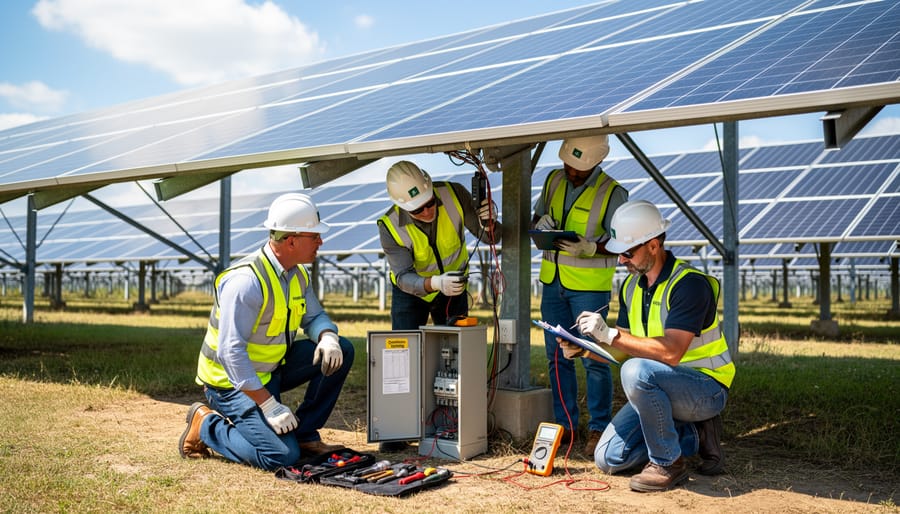
The gap between certification and field competence remains real, though. Most successful practitioners combine their online credentials with deliberate hands-on experience. Some programs facilitate partnerships with installers or manufacturers for shadowing opportunities. Others recommend volunteer work with community solar projects or internships alongside coursework.
The key is recognizing that certification provides the knowledge foundation and analytical framework, but those who master solar learning actively seek practical application beyond the final exam. The best approach treats certification as the first step in skill development rather than its completion.
Cost Considerations and Return on Investment
Program costs vary considerably, from around €800 for shorter certificates to €5,000 or more for comprehensive certification pathways spanning multiple courses. University-affiliated programs like Dalhousie’s 126-hour Certificate in Sustainable Energy Technologies typically fall in the €2,000-3,500 range, while professional association certifications may charge separately for exam fees and membership requirements. European institutions often price competitively compared to North American counterparts, though exchange rates and course materials can affect final costs.
Many employers in the renewables sector view certification as strategic workforce development. Project developers and installation companies increasingly sponsor employees through these programs, particularly when certifications address specific regulatory requirements or technical competencies the company needs. If you’re currently employed in energy, construction, or engineering, it’s worth exploring whether your organization has a professional development budget or skills gap it’s willing to address through your certification.
Evaluating ROI requires matching the certification’s focus to your career stage. For career changers, certification primarily opens doors, enabling applications to entry-level positions that require demonstrated renewable energy knowledge. Here, the return comes from access rather than immediate salary jumps. For established professionals adding specialization, certification often supports advancement to project leadership roles or specialized technical positions where salary increases of 15-25% are common within two years.
The less tangible returns matter too. Certification signals commitment to potential employers and clients, particularly in tendering processes where credentials differentiate consultants and contractors. It also builds networks through cohort learning and alumni communities, connections that frequently lead to project opportunities and industry visibility that compounds over time.

Online renewable energy certification in 2026 represents more than just another educational pathway. It’s a practical response to one of the most significant workforce challenges facing the energy transition: getting capable people into roles quickly enough to meet ambitious climate targets. These programs have matured considerably, offering genuine value when chosen carefully and approached with clear objectives.
The strongest programs balance accessibility with academic rigor, providing flexible learning without sacrificing depth. What matters most is alignment between your specific career goals and a program’s actual offerings. A career changer from construction needs different emphasis than a recent engineering graduate or a policy professional seeking technical grounding. The proliferation of options in 2026 means you can likely find that match, but it requires honest assessment of what you need versus what sounds impressive.
The renewable energy sector’s trajectory remains firmly upward across Europe and globally. Certification alone won’t transform you into an expert overnight, but it can compress your learning curve, signal commitment to potential employers, and provide the foundational knowledge that makes subsequent hands-on experience far more valuable. Combined with practical application, whether through internships, volunteer projects, or workplace initiatives, certification becomes a genuine accelerator rather than just a credential.
The energy transition needs skilled professionals at every level. If you’re willing to engage seriously with the material and apply what you learn, online certification can be your entry point.