
 Barbara
Integrate solar photovoltaic systems to power temperature-sensitive mixing processes, ensuring the precision heating and cooling cycles required for best vape juice production maintain consistent quality while reducing carbon emissions by up to 60%. European e-liquid manufacturers are discovering that renewable energy adoption isn’t merely an environmental choice—it directly influences product consistency, operational costs, and market competitiveness.
Implement wind energy contracts through Power Purchase Agreements to stabilize electricity costs for continuous manufacturing operations, particularly beneficial for facilities running 24/7 blending and bottling lines where energy represents 15-20% of production expenses. This approach has proven especially effective across Northern European manufacturing hubs where wind resources are abundant and grid integration is mature.
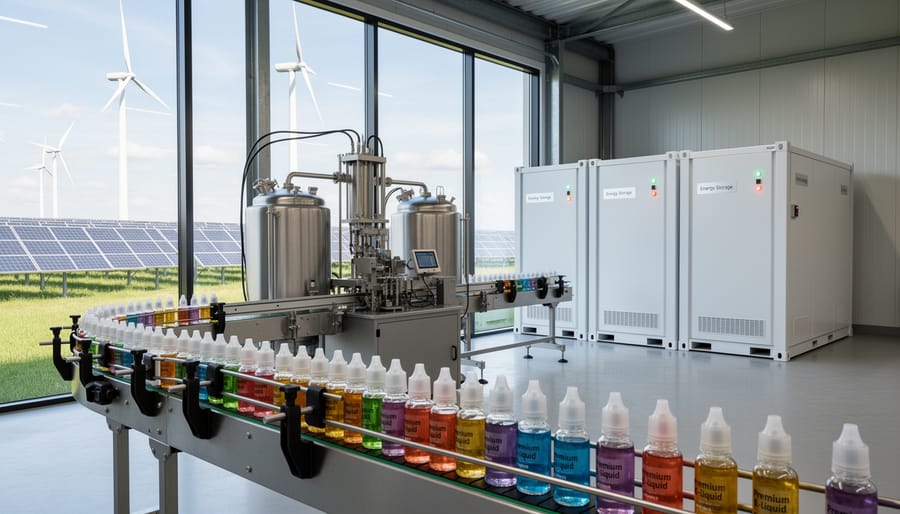
Deploy battery storage systems paired with renewable installations to manage peak demand during critical sterilization and clean room operations, preventing the quality compromises that occur when manufacturing processes experience power fluctuations or interruptions. This configuration ensures that sensitive ingredients like nicotine bases and flavor compounds are processed under optimal conditions regardless of renewable generation variability.
Calculate your facility’s specific energy profile by mapping consumption across mixing, filling, labeling, and quality control stages to identify which renewable technologies offer the highest return on investment. Most e-liquid facilities consume 200-500 kWh per thousand units produced, making them ideal candidates for distributed renewable systems that can be scaled progressively.
The intersection of clean energy and e-liquid manufacturing represents more than sustainability credentials. It addresses fundamental business challenges: energy cost volatility, supply chain resilience, regulatory compliance with emerging EU environmental standards, and consumer demand for transparently produced products. This transformation is reshaping how manufacturers approach both production efficiency and market positioning across European markets.
The Energy Demands of E-Liquid Manufacturing
Production Stages and Their Energy Footprint
E-liquid manufacturing involves several distinct production phases, each with unique energy demands that renewable sources can effectively address. Understanding these consumption patterns helps manufacturers identify optimization opportunities and transition strategies.
The mixing phase forms the foundation of e-liquid production, where base ingredients like propylene glycol, vegetable glycerin, nicotine, and flavourings combine in precise ratios. Industrial mixers typically operate continuously, consuming 2-5 kW per production line. This consistent baseload aligns well with renewable energy supply, particularly photovoltaic systems that provide steady daytime power when most mixing operations occur.
Heating represents a significant energy consumer, as ingredients require temperature control for proper viscosity and blending. Most facilities maintain mixing tanks between 40-60°C, with solar thermal technology offering an efficient solution for this moderate-temperature requirement. Heat pumps powered by renewable electricity provide an alternative approach, achieving coefficients of performance exceeding 3.0 in modern installations.
Sterilization and quality control phases demand more intensive energy inputs. UV sterilization systems consume approximately 1-3 kW per unit, while laboratory equipment for testing nicotine levels, pH balance, and contaminants requires stable electrical supply. These processes benefit from battery storage systems that ensure consistent power quality, protecting sensitive analytical instruments from voltage fluctuations.
Packaging operations, including bottle filling, capping, and labelling machinery, typically draw 3-8 kW depending on production scale. These automated systems operate in batches, creating flexibility for demand-response strategies where production timing shifts to match renewable generation peaks.
Across European facilities, total energy intensity ranges from 0.8-2.5 kWh per litre of finished product, with heating representing 40-50% of consumption, mixing 25-30%, and packaging 15-20%. This distribution highlights where renewable integration delivers maximum impact.
Why Clean Energy Matters for Product Integrity
E-liquid manufacturing demands exceptional precision and consistency, where even minor environmental fluctuations can compromise product integrity. Renewable energy systems offer distinct advantages over conventional grid power in maintaining the stable conditions essential for quality production.
Traditional grid electricity experiences voltage fluctuations, frequency variations, and sudden outages—all potentially disruptive to sensitive manufacturing processes. E-liquid production requires precise temperature control during mixing, consistent cleanroom conditions, and uninterrupted power for filtration systems. When grid instability causes equipment to cycle on and off repeatedly, it creates temperature variations that can alter viscosity, affect flavor compound stability, and potentially introduce contaminants during system restarts.
Modern renewable energy installations, particularly when paired with battery storage systems, provide remarkably stable power delivery. Solar arrays combined with intelligent inverters maintain consistent voltage output, while battery backup ensures seamless operation during production cycles. This stability translates directly to product quality: mixing tanks maintain exact temperatures, cleanroom HVAC systems operate continuously without interruption, and filling equipment functions with consistent precision.
Furthermore, renewable energy systems reduce contamination risks inherent in conventional power infrastructure. Grid-dependent facilities face exposure to power surges that can damage sensitive equipment or cause electromagnetic interference affecting electronic quality control systems. On-site renewable generation eliminates many transmission-related disturbances, creating a more controlled manufacturing environment.
For European manufacturers where stringent product safety regulations require documented quality control, renewable energy’s predictable performance characteristics simplify compliance while simultaneously advancing sustainability objectives. This dual benefit makes clean energy increasingly attractive for forward-thinking e-liquid producers prioritizing both environmental responsibility and manufacturing excellence.
Renewable Energy Solutions for E-Liquid Facilities
Solar Photovoltaic Systems for Production Facilities
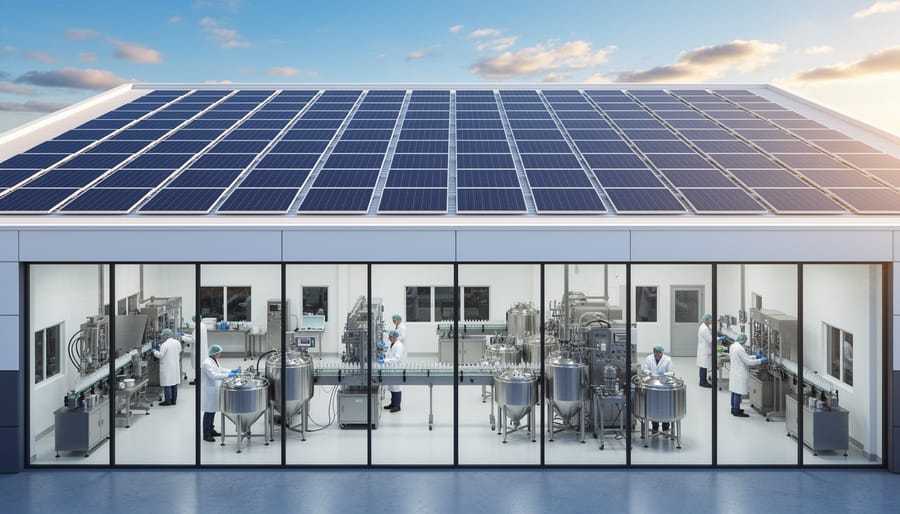
Solar installations represent one of the most viable renewable energy solutions for e-liquid manufacturing facilities across Europe. Photovoltaic systems can be deployed either as rooftop installations on existing manufacturing buildings or as ground-mounted arrays on adjacent land, depending on available space and energy requirements.
Rooftop solar proves particularly attractive for urban production facilities where land is limited. A typical medium-sized e-liquid manufacturing plant in Germany, for instance, can install 150-200 kW of rooftop solar capacity, generating approximately 140,000-180,000 kWh annually. This output can cover 30-40% of total operational energy demand, including mixing equipment, climate control for storage areas, and lighting systems.
Ground-mounted installations offer greater flexibility for larger operations. A Netherlands-based e-liquid producer recently implemented a 500 kW ground-mounted array that provides nearly 65% of their facility’s electricity needs. The system includes battery storage to ensure consistent power during mixing and bottling processes, which require stable energy supply to maintain product consistency.
European e-liquid manufacturers benefit from supportive regulatory frameworks and feed-in tariffs in countries like Spain, Italy, and Portugal. Net metering arrangements allow facilities to sell excess generation back to the grid during low-production periods while drawing power when needed. Installation costs have decreased by approximately 80% over the past decade, with typical payback periods now ranging from 6-9 years. The combination of reduced operating costs and improved sustainability credentials makes solar integration increasingly essential for competitive e-liquid manufacturing operations.
Wind Energy Integration for Larger Operations
For medium to large-scale e-liquid manufacturers, particularly those operating in Northern European regions with favorable wind conditions, wind energy integration presents compelling opportunities. Countries like Denmark, the Netherlands, and coastal Germany offer exceptional wind resources that can substantially reduce operational energy costs while achieving sustainability targets.
Facilities consuming 500 MWh or more annually should consider on-site turbine installations or dedicated wind farm partnerships. A single modern 3 MW turbine can generate sufficient electricity to power several manufacturing lines continuously, covering processes from ingredient mixing to bottling and packaging. For manufacturers without suitable on-site locations, Power Purchase Agreements (PPAs) with nearby wind farms provide stable, long-term energy pricing while supporting grid decarbonization.
The intermittent nature of wind power requires careful energy management strategies. Manufacturers can optimize production schedules to align high-consumption processes with peak wind generation periods, supported by real-time wind forecasting systems. Battery storage systems, though representing additional investment, enable facilities to store excess wind-generated electricity during high-output periods for use during calm conditions.
Northern European manufacturers benefit from robust renewable energy infrastructure and supportive regulatory frameworks, including feed-in tariffs and grid priority access for renewable sources. These advantages make wind power economically viable while demonstrating environmental leadership to increasingly sustainability-conscious distributors and consumers.
Hybrid Renewable Systems and Energy Storage
Relying on a single renewable source creates vulnerabilities in manufacturing operations, particularly for processes requiring stable conditions like e-liquid production. Hybrid renewable systems address this limitation by combining complementary technologies—such as solar photovoltaic panels with wind turbines—to create more consistent energy availability throughout varying weather conditions and seasons.
In European contexts, solar generation typically peaks during summer months whilst wind resources often prove strongest during winter periods. This natural complementarity reduces supply gaps when integrated strategically. Manufacturing facilities across Germany and Denmark have successfully implemented such combinations, maintaining production continuity whilst achieving 85-95% renewable energy coverage annually.
Battery storage systems form the critical third component, bridging remaining intermittency gaps. Modern lithium-ion and emerging flow battery technologies store excess generation during peak production periods, releasing power when renewable output dips. For e-liquid manufacturing, this ensures the precision temperature control and consistent mixing speeds essential for product quality remain unaffected by external weather fluctuations.
Sizing storage capacity requires careful analysis of production schedules and energy demand patterns. Many European manufacturers opt for 4-8 hours of backup capacity, sufficient to maintain operations through typical renewable generation lulls whilst remaining economically viable. Advanced energy management systems automatically orchestrate power flow between generation sources, storage, and production equipment, optimising efficiency and minimising grid dependency.
This integrated approach transforms renewable energy from an intermittent resource into a reliable foundation for quality-sensitive manufacturing, demonstrating that sustainability and operational excellence need not conflict but rather complement each other when properly engineered.
The Quality Connection: Renewable Energy and Premium E-Liquids
Cleaner Production Environments
Renewable energy systems contribute significantly to cleaner production environments in e-liquid manufacturing facilities, directly impacting product purity. Unlike conventional fossil fuel-based power generation, which can introduce airborne particulates and contaminants into manufacturing spaces, renewable energy sources like solar and wind produce electricity without combustion byproducts. This fundamental difference creates measurably cleaner air quality within production facilities.
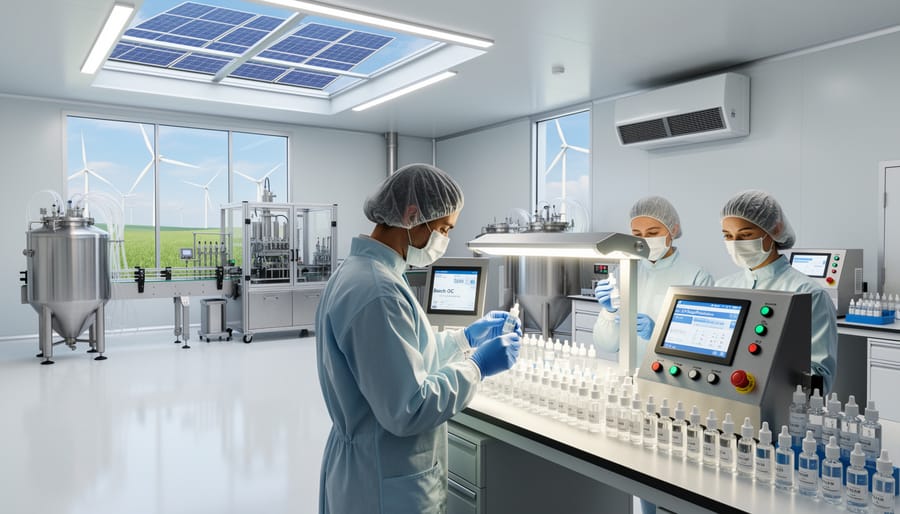
Manufacturing e-liquids requires stringent cleanroom conditions to prevent contamination of these consumable products. Traditional energy infrastructure, particularly diesel generators used as backup power or in off-grid facilities, releases microscopic particulate matter that can infiltrate even filtered environments. These particles pose contamination risks during critical manufacturing stages, including ingredient mixing and bottling. By contrast, photovoltaic systems and wind turbines generate power without emitting pollutants, reducing the baseline contamination load that ventilation and filtration systems must address.
European manufacturers implementing renewable energy solutions report measurable improvements in air quality monitoring data. Solar installations eliminate localized emissions entirely, whilst combined heat and power systems using biogas from controlled anaerobic digestion produce significantly fewer contaminants than conventional generators. This cleaner operational environment reduces the frequency of batch rejections due to particulate contamination.
The practical benefit extends beyond immediate air quality. Reduced airborne contaminants mean less frequent replacement of expensive HEPA filtration systems and lower cleaning protocol requirements. For manufacturers pursuing ISO cleanroom certifications, renewable energy integration supports compliance whilst simultaneously advancing sustainability objectives. This dual benefit makes renewable energy particularly attractive for European e-liquid producers navigating increasingly stringent product safety regulations and environmental standards.
Certification and Market Advantages
E-liquid manufacturers powered by renewable energy can pursue several recognised sustainability certifications that provide significant market advantages across Europe. The ISO 14001 Environmental Management System certification demonstrates systematic environmental commitment, while the EU Ecolabel and Nordic Swan certifications specifically recognise products with reduced environmental impact throughout their lifecycle. For facilities utilising renewable energy, the EKOenergy label certifies that electricity comes from sustainable sources meeting strict environmental criteria.
These certifications offer tangible competitive benefits in the European market, where consumer awareness of sustainability continues growing. Certified manufacturers report enhanced brand reputation, increased consumer trust, and preferential treatment from distributors prioritising environmental responsibility. Retail chains increasingly favour suppliers with verified sustainability credentials, creating market access advantages. Research indicates that 73% of European consumers consider environmental impact when purchasing, with many willing to pay premium prices for certified sustainable products.
From a business perspective, certification strengthens B2B relationships and opens procurement opportunities with organisations maintaining strict sustainability requirements. The certification process also identifies operational improvements, often reducing costs through enhanced efficiency. Additionally, renewable-powered facilities may qualify for favourable financing terms from banks offering green lending programmes. As European regulations tighten around manufacturing emissions, early certification positions manufacturers ahead of compliance requirements, transforming sustainability from optional enhancement into essential market positioning.
Consumer Preferences Driving the Transition
European consumer behaviour demonstrates a measurable shift towards sustainability in vaping product selection. Recent market surveys indicate that approximately 62% of European e-liquid consumers now consider environmental production practices when making purchasing decisions, with this figure rising to 74% among consumers aged 25-40. Manufacturers adopting renewable energy solutions report an average 18% increase in brand preference compared to conventional competitors.
This trend manifests practically through purchase patterns. Retailers across Germany, France, and the Netherlands note consistent sales growth for products bearing renewable energy certifications or transparent sustainability credentials. Third-party verification programmes, such as those confirming solar or wind-powered manufacturing facilities, have become valuable marketing assets. The willingness to pay a modest premium—typically 8-12%—for sustainably produced e-liquids further validates this transition. This consumer-driven momentum creates tangible business incentives for manufacturers to invest in renewable energy infrastructure, transforming environmental responsibility from optional practice into competitive necessity within the European e-liquid sector.
Implementation Roadmap for E-Liquid Manufacturers
Energy Audit and Renewable Potential Assessment
Conducting a comprehensive energy audit forms the foundation for transitioning e-liquid manufacturing facilities to renewable power. Begin by analyzing electricity consumption patterns across all operational phases: raw material storage (climate control), mixing equipment, heating systems for viscosity management, cleanroom ventilation, and quality control laboratories. Most European e-liquid facilities consume between 50-200 kWh per production day, depending on scale and automation levels.
Document peak demand periods, which often coincide with batch mixing and sterilization processes. This data reveals whether solar photovoltaic systems, wind turbines, or hybrid solutions best match your consumption profile. Facilities in Southern European regions (Spain, Italy, Greece) typically benefit most from rooftop solar installations, potentially covering 60-80% of daytime energy needs. Northern locations may require supplementary wind power or grid storage solutions.
Assess your facility’s physical characteristics: roof orientation and load capacity for solar panels, available land for ground-mounted systems, and proximity to existing grid infrastructure. Consider local renewable incentives—many EU member states offer feed-in tariffs, tax credits, or accelerated depreciation schemes that significantly improve project economics.
Engage certified energy auditors familiar with pharmaceutical-grade manufacturing standards, as e-liquid production shares similar cleanroom and environmental control requirements. Their assessment should identify specific renewable technologies aligned with your production schedule, budget constraints, and sustainability targets, creating a realistic implementation roadmap.
Financial Incentives and Support Programs in Europe
European e-liquid manufacturers transitioning to renewable energy can access substantial financial support through multiple channels. At the EU level, the Innovation Fund provides significant grants for clean technology deployment in industrial facilities, with recent calls specifically targeting energy-intensive manufacturing sectors. The European Investment Bank offers green loans with favorable interest rates for renewable energy infrastructure, particularly beneficial for mid-sized manufacturing operations.
National programs vary considerably across member states. Germany’s Federal Funding for Energy and Resource Efficiency in the Economy (EEW) covers up to 55% of renewable energy system costs for manufacturing facilities. France’s ADEME grants support photovoltaic and biomass installations, while Spain’s IDAE offers subsidies reaching 40% for industrial solar projects. The Netherlands provides tax deductions through the Energy Investment Allowance (EIA), allowing manufacturers to deduct 45.5% of renewable energy investments from taxable profits.
Several countries combine direct grants with accelerated depreciation schemes, enabling manufacturers to recover costs rapidly. Additionally, many regions offer feed-in tariffs or power purchase agreements that guarantee returns on excess renewable electricity generated. Manufacturers should engage with regional energy agencies early in planning phases to maximize available support and navigate application procedures effectively.
Partnering with System Integrators and Energy Specialists
Selecting the right partners is essential for seamlessly integrating renewable energy into e-liquid manufacturing operations. European manufacturers should prioritize system integrators with proven experience in industrial facilities, particularly those handling sensitive production environments requiring consistent power quality and minimal downtime.
When evaluating potential providers, request case studies from similar manufacturing sectors, verify certifications such as ISO 50001 for energy management systems, and assess their understanding of pharmaceutical-grade production requirements. Quality partners will conduct thorough energy audits before proposing solutions, identifying opportunities to align renewable installations with existing electrical infrastructure.
Collaboration should extend beyond initial installation. Leading integrators offer specialized training programs to upskill facility staff in renewable system maintenance and monitoring, ensuring long-term operational efficiency. This knowledge transfer proves particularly valuable during system optimization phases.
Phased implementation approaches minimize production disruptions. Many European manufacturers successfully transition by starting with supplementary renewable capacity during lower production periods, gradually expanding as confidence and expertise grow. This strategy allows real-time testing while maintaining manufacturing continuity and product quality standards throughout the energy transition process.
Future Outlook: Renewable Energy as Industry Standard
Regulatory Pressures and Sustainability Mandates
European e-liquid manufacturers face an increasingly stringent regulatory landscape that positions renewable energy as essential rather than optional. The European Green Deal, targeting climate neutrality by 2050, establishes framework conditions affecting industrial production across all sectors. The Corporate Sustainability Reporting Directive (CSRD), which came into force in January 2023, requires companies meeting specific thresholds to disclose their environmental impact, including energy consumption and carbon emissions.
For e-liquid manufacturers, these mandates translate into practical obligations. The EU Emissions Trading System (ETS) expansion and Carbon Border Adjustment Mechanism (CBAM) create financial incentives for reducing carbon footprints throughout production processes. Additionally, the proposed Ecodesign for Sustainable Products Regulation aims to establish sustainability criteria for a broader range of products, potentially including consumables like e-liquids.
National implementations add further momentum. Germany’s Supply Chain Due Diligence Act and France’s climate disclosure requirements exemplify member states exceeding minimum EU standards. These regulations increasingly require manufacturers to document energy sources and demonstrate measurable progress toward renewable adoption.
The Tobacco Products Directive, while primarily focused on safety and labeling, is anticipated to incorporate sustainability considerations in future revisions. Forward-thinking manufacturers recognize that transitioning to renewable energy now positions them advantageously for inevitable regulatory tightening while simultaneously meeting growing retailer and consumer expectations for sustainable products.
Technological Innovations Reducing Implementation Barriers
Recent technological advances are dramatically lowering the barriers for small and medium-sized e-liquid manufacturers to adopt renewable energy solutions. Modular solar photovoltaic systems now offer scalable options, allowing producers to start with partial installations and expand capacity as budgets permit. These plug-and-play systems require minimal technical expertise and can be integrated incrementally without disrupting production schedules.
Battery storage technology has become particularly transformative, with prices dropping by approximately 89% over the past decade across European markets. Modern lithium-ion and emerging solid-state batteries enable manufacturers to store excess renewable energy generated during peak production hours, ensuring consistent power availability for temperature-sensitive processes even during low-generation periods.
Smart energy management systems represent another breakthrough, utilizing artificial intelligence to optimize energy consumption patterns. These platforms automatically shift high-intensity operations like mixing and bottling to periods when renewable generation peaks, maximizing clean energy utilization whilst reducing grid dependence. Many European suppliers now offer these systems with intuitive interfaces requiring no specialized programming knowledge.
Furthermore, community solar schemes and virtual power purchase agreements provide renewable access without requiring on-site installations. These arrangements particularly benefit urban manufacturers with limited roof space, allowing participation in the energy transition through financial commitments rather than physical infrastructure investments, democratizing sustainable manufacturing across the sector.
The integration of renewable energy into e-liquid manufacturing represents far more than an environmental gesture—it has emerged as a fundamental pillar for producing superior products while maintaining market competitiveness. Throughout this exploration, we’ve examined how solar, wind, and biomass energy systems provide the consistent, clean power necessary for precision mixing, temperature-controlled steeping, and contamination-free production environments. European manufacturers are demonstrating that sustainability and quality are not competing priorities but complementary objectives that strengthen both product integrity and brand reputation.
The convergence of renewable energy adoption with e-liquid production addresses multiple industry challenges simultaneously. Manufacturers benefit from reduced operational costs, enhanced product consistency, and alignment with increasingly stringent environmental regulations. Consumers gain access to e-liquids produced under optimal conditions, while the broader community benefits from reduced carbon emissions and local energy independence. This triple advantage positions renewable-powered facilities at the forefront of industry evolution.
For manufacturers, project developers, and stakeholders considering this transition, the pathway forward requires structured knowledge and strategic planning. Exploring renewable energy training programs provides essential insights into system design, implementation strategies, and financial modeling specific to manufacturing applications. Organizations should assess their current energy profiles, investigate available incentives within their regions, and connect with experienced system integrators familiar with cleanroom and precision manufacturing requirements. The future of premium e-liquid production is inextricably linked to clean energy—the time to act is now.


