Barbara
You can learn renewable energy at a distance with a laptop, a stable internet connection, a handful of free simulation tools, and a weekly routine that mixes structured courses with hands-on practice. Expect to spend three to five hours a week for a few months to reach a working grasp of the basics, such as how a solar PV system is sized or how a wind turbine’s output follows wind speed. The difficulty is beginner to intermediate, and the only real prerequisite is comfort with basic arithmetic and a willingness to experiment.
Why does it work? Energy transition knowledge is increasingly digital by nature. Across Europe, universities, training bodies and industry groups now publish lectures, open datasets and design software that anyone can reach from home. You can model a rooftop array in a free yield calculator, read real grid data, and follow a module on heat pumps without leaving your desk.
Passive viewing is where most learners get stuck. Watching a lecture on inverters (the devices that convert solar panels’ direct current into the alternating current your home uses) feels productive, yet the knowledge only sticks once you size one yourself. The sections below show what you need, how to stay safe, the order to learn in, and how to check your progress.
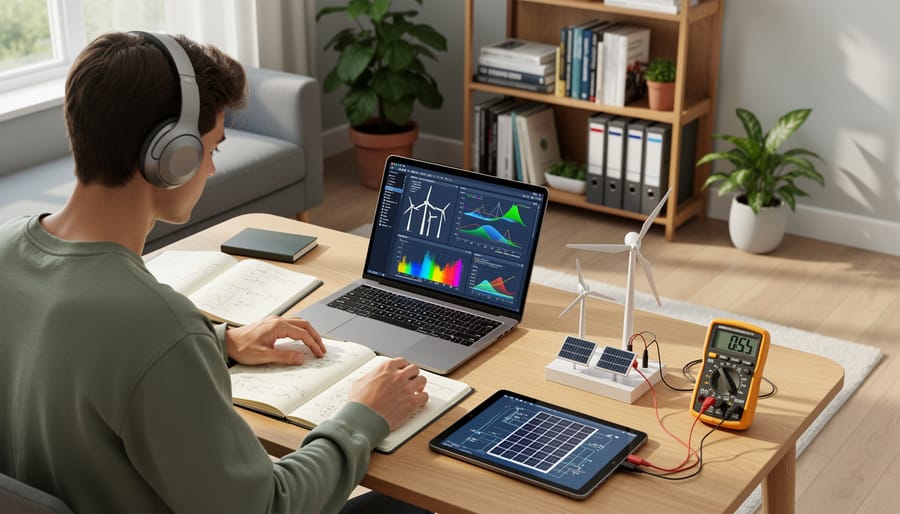
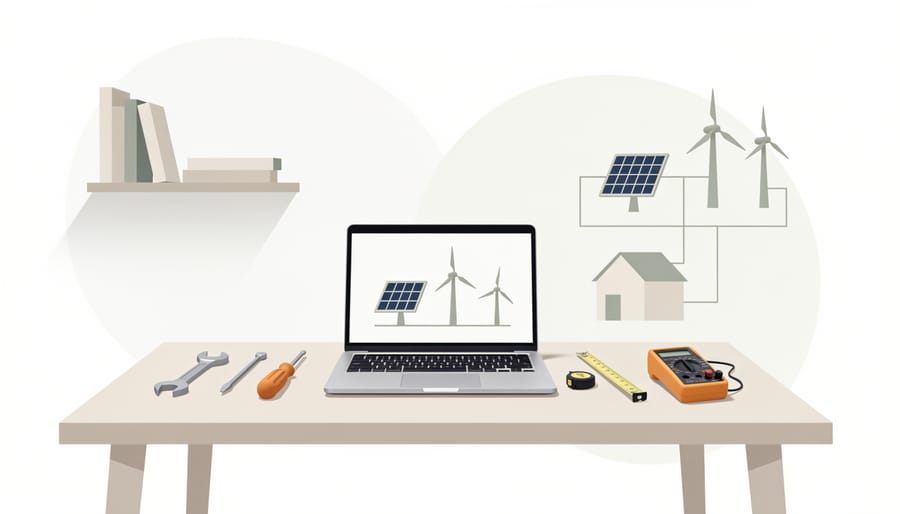
Tools and Materials for Online Renewable Energy Study
Learning Platforms and Formats: Courses, Seminars and Summits
Three formats cover most distance learning in renewable energy, and each does a different job.
Self-paced courses suit building foundations. You work through recorded lectures, readings and quizzes whenever your schedule allows, which helps if you juggle project deadlines or travel. Choose this format when you need a solid grounding in photovoltaics, wind or solar thermal basics, or when you must revisit material before applying it on a project.
Live seminars add interaction. A scheduled session lets you put questions to an instructor, hear how others solve the same design problem and get feedback in real time. They work well when you are stuck on a specific topic, such as grid connection requirements or system sizing, and want an expert to explain the reasoning rather than just the answer.
Virtual summits are broader and shorter. Several speakers cover market trends, policy updates and case studies across a day or two. They will not teach you a skill from scratch, but they are excellent for spotting emerging technologies and building contacts in the European energy transition community.
A simple way to decide: match the format to the goal. Starting a new specialisation? Begin with a self-paced course. Preparing for a particular project? Add live seminars. Looking to widen your professional network or follow the sector’s direction? Attend a summit.
Many learners combine all three, using the course for depth, the seminar for clarity and the summit for context.
Simulation and Design Software You Can Use From Home
You don’t need a rooftop or a wind mast to practise real engineering decisions. Desktop and browser-based tools let you model whole systems from a laptop, and several are free.
For photovoltaics, the European Commission’s PVGIS web tool is a good starting point. It estimates yearly energy output for a given location, tilt and orientation using irradiance data covering Europe, so you can see how a south-facing roof in Lisbon differs from one in Helsinki. Commercial packages such as PVsyst, PV*SOL and SAM (the System Advisor Model, which is free) go further. They let you choose modules and inverters, size the array, estimate shading and system losses, and compare “performance ratio” results, which is simply the share of theoretical output a real system delivers.
For wind, WAsP is the long-standing industry tool for wind resource assessment, estimating how a site’s terrain and obstacles shape the wind. Open-source options such as PyWake or OpenWind let you practise layout and wake-loss modelling, where one turbine reduces the wind reaching another. Public data from the Global Wind Atlas gives you realistic inputs to work with.
For solar thermal, Polysun and the free TRNSYS-based or spreadsheet-driven calculators used in many courses help you size collector areas and storage tanks against a household’s hot water demand. You can then test how changing tank volume affects the solar fraction, the share of heat supplied by the sun.
Start with one free tool, repeat the same sizing exercise with different assumptions, and note what changes. That habit of questioning your inputs matters more than mastering any single package.
Safety and Reality Checks Before You Practise Hands-On
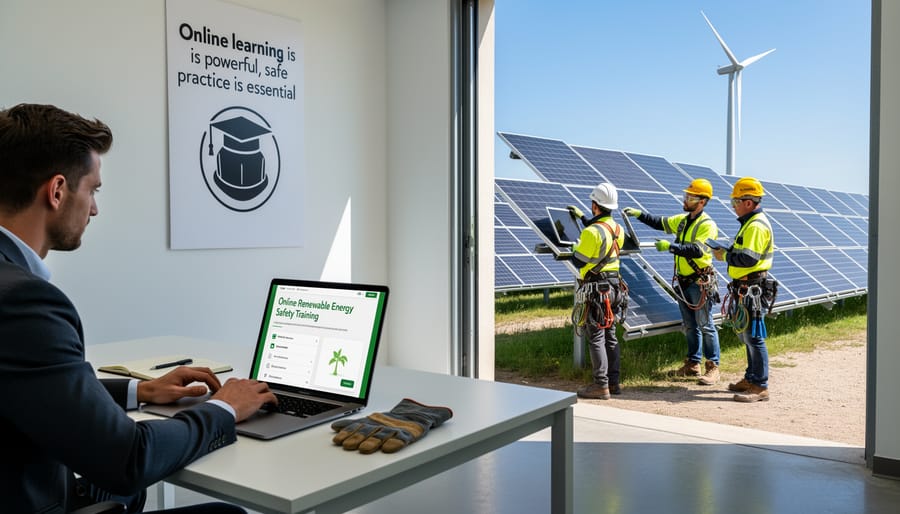
Most distance learning happens on a screen, and that is exactly why this section matters. The moment you move from a simulation to a real rooftop, wind mast or switchboard, you face hazards that no course platform can reproduce: live electrical circuits, falls from height, heavy moving components and stored energy in batteries and inverters.
Treat online study as preparation, not a licence. Virtual training builds understanding, vocabulary and design judgement, and it can help you master solar learning fundamentals before you ever step on a site. It does not replace supervised, certified on-site training. Even a well-designed course cannot assess your technique, your response to a fault or your judgement under real conditions.
Local rules also apply. Electrical installation work is regulated differently across EU member states, and many countries require a recognised qualification or registration before you can connect or commission a system. Check what your national authority expects before planning any practical follow-up, and work under a qualified installer or instructor while you build experience.
On the digital side, be cautious about what a course claims. Before you pay, verify the following:
– Who accredits or recognises the programme, and whether you can confirm that with the accrediting body directly.
– Whether the certificate is a certificate of completion or an actual professional qualification. These are not the same thing.
– Whether any promise of “job-ready” or “installer-certified” status is backed by evidence you can check.
Be wary of vague or unsupported certification claims. A trustworthy provider will state plainly what the course does and does not qualify you to do.
Step-by-Step: Building a Distance Learning Routine That Works
Turning Theory Into a Practical Project
A good first project is sizing a rooftop PV system for a house you know, or a fictional one. You don’t need a site visit. You need a simulation tool, publicly available European irradiance data (the EU’s PVGIS service is a common free choice) and a few basic inputs.
Start with the roof: its tilt, its direction and any shading from trees or chimneys. Then pull the local solar irradiance, which is simply how much sunlight energy reaches each square metre over a year. Feed this into the simulation tool, which estimates yield, meaning the kilowatt-hours your array should produce. Compare that yield against the household’s annual electricity use and adjust the number of panels until the two roughly match. For a small wind site, the logic is the same, but you work from published wind speed data and the turbine’s power curve instead.
If you’re still deciding where to begin, it helps to choose the right training first, then follow a simple sequence:
- Define your learning goal and role, for example sizing small PV systems as a junior system integrator.
- Pick a course format that fits that goal: self-paced, live seminar or both.
- Set up your tools and workspace, including simulation software and a stable connection.
- Schedule fixed weekly study blocks and protect them in your calendar.
- Engage with instructors and peers in forums and live sessions to test your assumptions.
- Complete the practical simulation project, recording every input and result.
- Apply your findings to a real or case-study project, noting where the model and reality might differ.
Keep your notes as you go. They become the first entry in your portfolio.
Staying Connected: Learning With a European Community
Learning alone at a screen can feel isolating, but connecting with other European learners turns a course into a working network. Discussion forums and cohort chats are good places to ask the practical questions that lectures rarely cover: how permitting timelines differ between member states, what grid operators expect from a new connection, or how a developer handled a tricky site assessment.
Virtual summits add a wider view. Hearing from practitioners in different markets shows how national rules and local conditions shape the same technology. A wind specialist in the North Sea region and a solar installer in southern Europe face quite different constraints, yet both discuss the same grid integration challenges, such as managing variable output and meeting connection requirements. If you are curious about the wider case for these resources, it helps to understand why wind matters to long-term energy planning before joining those conversations.
To get real value, contribute as well as read. Post a question about your mini project, share a source you found useful, and respond when someone else is stuck. Keep notes on the market-specific points you pick up, since they become useful reference material when you later work on projects across Europe.
How to Verify What You’ve Learned and Plan Next Steps
Finishing a course is not the same as being able to use what it taught. The simplest test is whether you can do the work without the lecture open beside you. Quizzes catch gaps in vocabulary, project reviews show whether your reasoning holds up, and instructor feedback tells you where your logic wandered. A certificate is useful, but it records attendance and assessment, not your judgement.
Try checking yourself against a short list:
- You can size a basic PV or solar thermal system for a given household load.
- You can explain key terms such as capacity factor, performance ratio and curtailment in plain language.
- You can read a yield report and spot which assumptions drive the result.
- You can justify your design choices, including trade-offs, to a sceptical colleague.
- You can name where your simulation might differ from a real site.
If one of these feels shaky, revisit that module before moving on. Then ask whether the course outcomes match what employers and project teams actually need. Compare the skills you practised with the tasks in current job descriptions, grid connection requirements and relevant IEC or EU frameworks.
From here, the next step depends on your goal. If you want depth, take an advanced module in a single specialisation. If you want hands-on competence, book supervised on-site training, which online learning cannot replace. Learners weighing formal study can read about the online degree career route, while those drawn to field work may find the wind technician pathway a practical starting point. Either way, apply your skills soon, perhaps on an efficiency or generation project inside your own organisation.
Common Questions About Learning Renewable Energy Online
Most learners ask the same handful of questions before they enrol. Here are straight answers to the ones that come up most often.
Can online courses lead to recognised qualifications?
Some do, but it depends on the provider and the course. Check whether the programme is accredited or awarded by a recognised institution, and ask what the certificate actually certifies. A certificate of completion shows you finished the material, while a formal qualification usually involves assessment and external recognition.
How much time should I plan per week?
A realistic range for most self-paced courses is three to six hours a week, though this varies with the course depth. Consistency matters more than length, so a fixed weekly slot beats occasional long sessions.
Do I need an engineering background?
Not for introductory courses. Good programmes explain terms such as capacity factor or grid integration from first principles. Basic comfort with numbers and units helps, and more advanced modules on design or modelling will build on that foundation.
How do I get practical experience remotely?
Use simulation tools to size a rooftop PV system or assess a small wind site with public European data. These projects build real skills and give you something concrete for a portfolio. Hands-on work on live installations should still happen under certified supervision.
Another common concern is whether what you learn will travel across borders. Many of the principles, from resource assessment to system sizing, apply throughout Europe. Permitting rules, grid codes and support schemes differ by country, so treat national regulations as a layer to study separately for the market you work in. Forums and live sessions are a good place to compare how different member states handle these details.
Where you live no longer limits how well you can learn renewable energy. With a reliable connection, a good learning platform and a simulation tool, you can study photovoltaics, wind or solar thermal from your kitchen table and still build skills that matter across Europe’s energy transition.
Start small. Pick one format, whether that’s a self-paced course, a live seminar or a virtual summit, and set yourself one modest project, like sizing a rooftop PV system with public irradiance data. Finish that, document it, and the next step will feel obvious.
When you’re ready for more structure, explore the Adapted Learning with Renewables programs.